
 EN
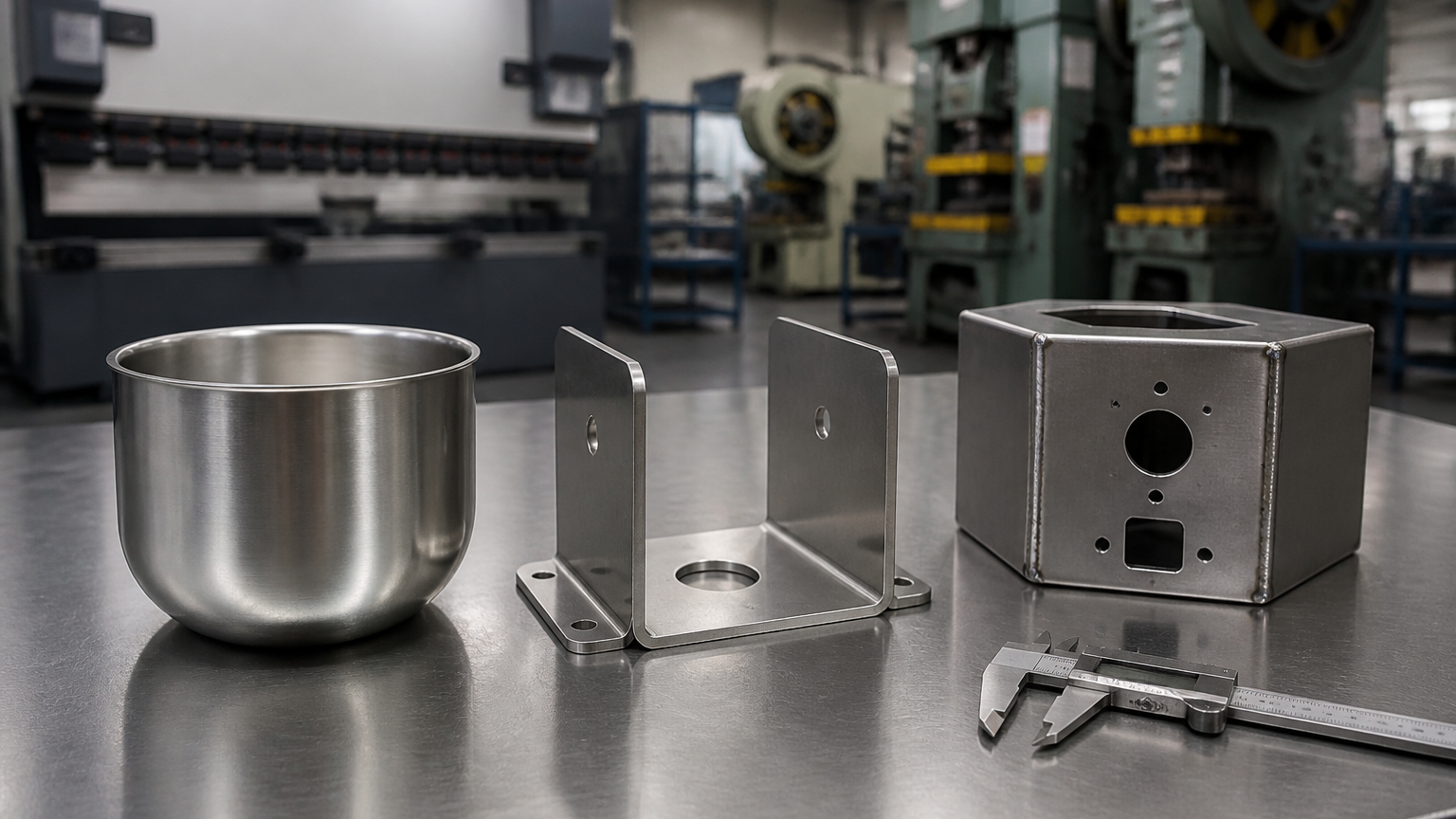
Physical capability samples—a drawn cup, a formed bracket and a welded housing—show what processes a supplier actually runs in-house.
Quick answer: how do you vet a custom metal parts supplier before placing an order?
Vetting a custom metal parts supplier means checking five things before you commit budget: a documented quality system (ISO 9001 or equivalent), verifiable material traceability (mill test reports tied to heat/batch numbers), a first-article sample review against your drawing before mass production, realistic lead time with evidence of on-time delivery, and export-ready packaging for your destination market. Skipping any one of these is how buyers end up with parts that look fine in photos but fail on the loading dock, in the warehouse, or on the assembly line.
The buying decision usually comes down to three sourcing routes: a direct factory, a trading company or agent, and an online manufacturing platform or marketplace. Each route changes who answers for quality problems, how fast you get a quote, and how much visibility you have into the actual production process.
Direct factory vs trading company vs online sourcing platform: who do you actually hold accountable?
| Factor | Direct factory | Trading company / agent | Online sourcing platform |
|---|---|---|---|
| Who answers for defects | The factory itself; direct engineering contact | The trader relays claims to an unnamed factory | Platform policy, often with a verified-supplier badge |
| Price transparency | Usually itemized tooling, material and labor cost | Markup is hidden inside a bundled quote | Listed price, but specs may be templated, not custom |
| Engineering collaboration | Direct access to process engineers for DFM feedback | Feedback passes through a non-technical middle layer | Limited to listing Q&A or chat; weak for complex parts |
| Material traceability | Can request heat/batch-linked mill test reports directly | Traceability depends on the trader forwarding documents | Often unavailable for standardized catalog items |
| Lead time visibility | Factory can show real production schedule status | Added buffer time with limited visibility into delays | Platform-estimated, not always tied to actual capacity |
| Best fit | Custom parts, recurring volume, tight tolerances | Low-value one-off buys where effort matters more than control | Simple standardized parts, small trial orders |
None of the three routes is universally "better." A direct factory route earns its advantage specifically for custom, tolerance-sensitive, or recurring-volume parts, where engineering collaboration and traceability reduce risk. A trading company can make sense for a single simple item when you have no time to vet a factory. A platform is reasonable for standardized components where specification risk is low.
Quality management system: ask for the certificate, then ask how it is used
An ISO 9001 certificate confirms a documented quality management system exists; it does not confirm the supplier actually follows it on your order. During vetting, ask how nonconformities are logged, who approves engineering changes, and whether incoming material inspection happens on every batch or only on sampling. A supplier that can describe a concrete corrective-action process for a past defect is a stronger signal than a framed certificate on the wall. Cross-check quality claims against our quality assurance and inspection process for the kind of documentation you should expect at each stage.
Material certification and traceability: verify, don’t assume
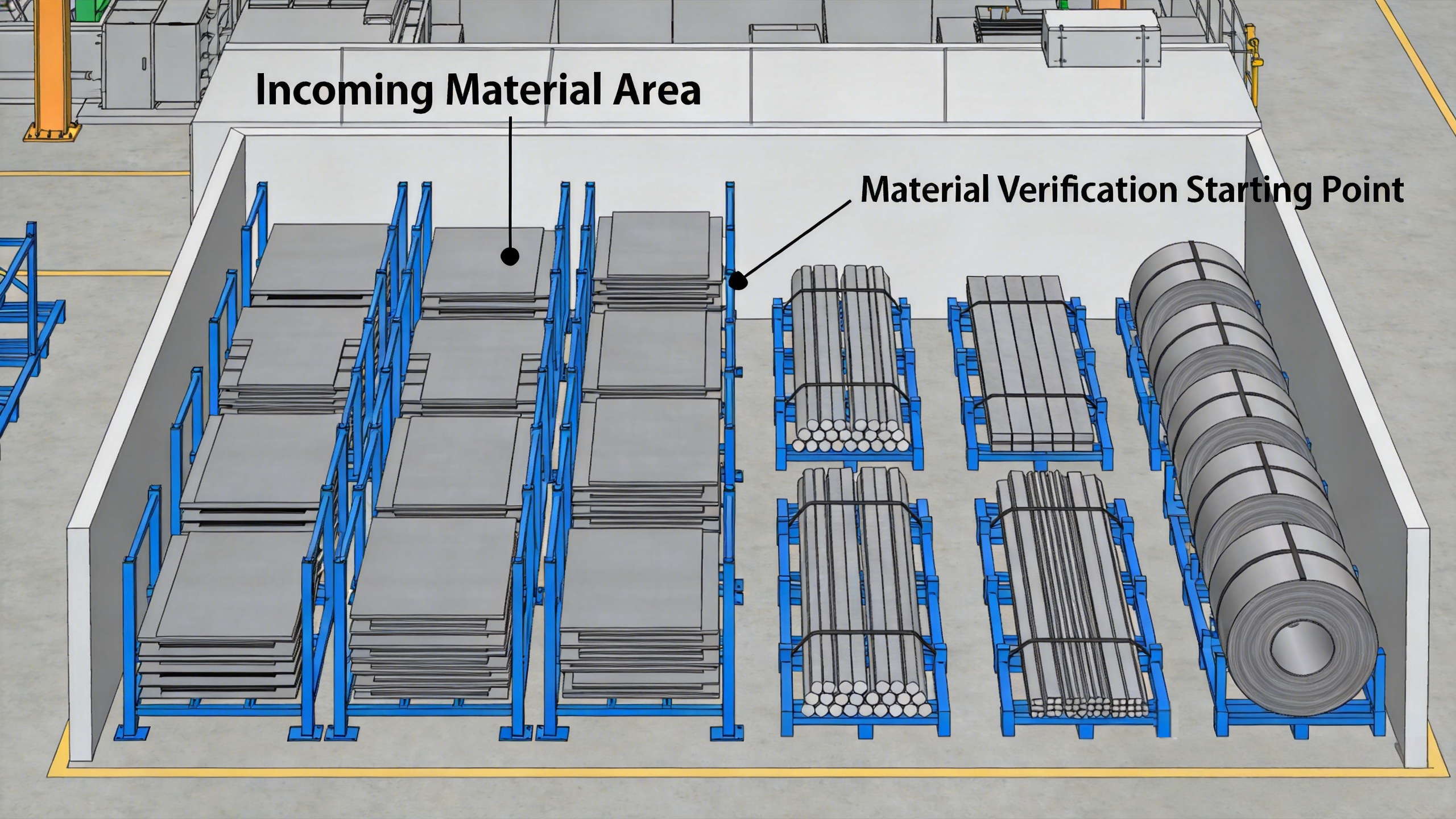
Consistent raw sheet, bar and coil stock in the incoming material area is the physical starting point for material verification.
For stainless steel, aluminum and carbon steel parts, request a mill test report (MTR) that lists chemical composition and mechanical properties, tied to a heat number or batch number you can match against the parts you receive. If a supplier cannot produce a heat-number-linked certificate for a stated grade such as 304 or 316 stainless steel, treat the material claim as unverified. Material substitution without notice is one of the most common root causes of field failures in corrosive or load-bearing applications; our metal materials guide explains how grade selection affects corrosion resistance and mechanical performance.
First-article sample review: the checkpoint that prevents a bad production run
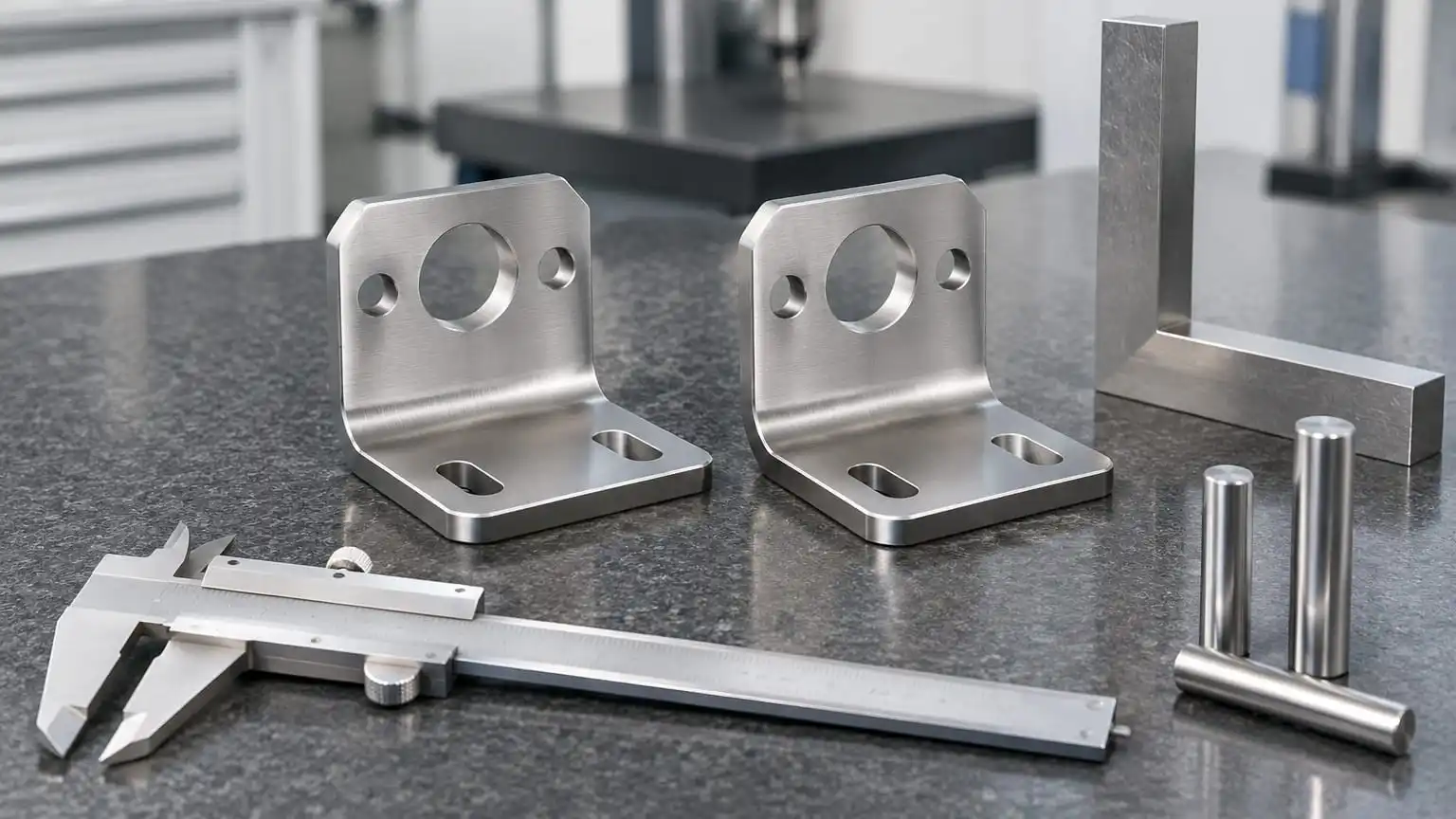
Checking physical sample brackets with a mechanical caliper, square and pin gauges catches dimensional drift before mass production.
Never approve a production order from photos alone. Request a first-article sample and compare it against your engineering drawing's critical dimensions, hole positions, and surface finish callouts — ideally with your own caliper or gauge, not only the supplier's report. For tolerance-sensitive sheet metal, stamped, or deep-drawn parts, this step is where bend angle drift, hole ovality, or wall-thickness variation surfaces before you commit to hundreds or thousands of units. Our guide to sheet metal and stamping tolerances explains which dimensions deserve tighter tolerance callouts and which can stay at general profile tolerance to control cost. If your part also needs a decision between forming routes, see our comparison of deep drawing vs progressive stamping vs sheet metal fabrication and our custom sheet metal DFM and prototype-to-production guide for how design choices affect first-article pass rates.
Lead time, production capacity and export packaging: the part buyers check last and regret most
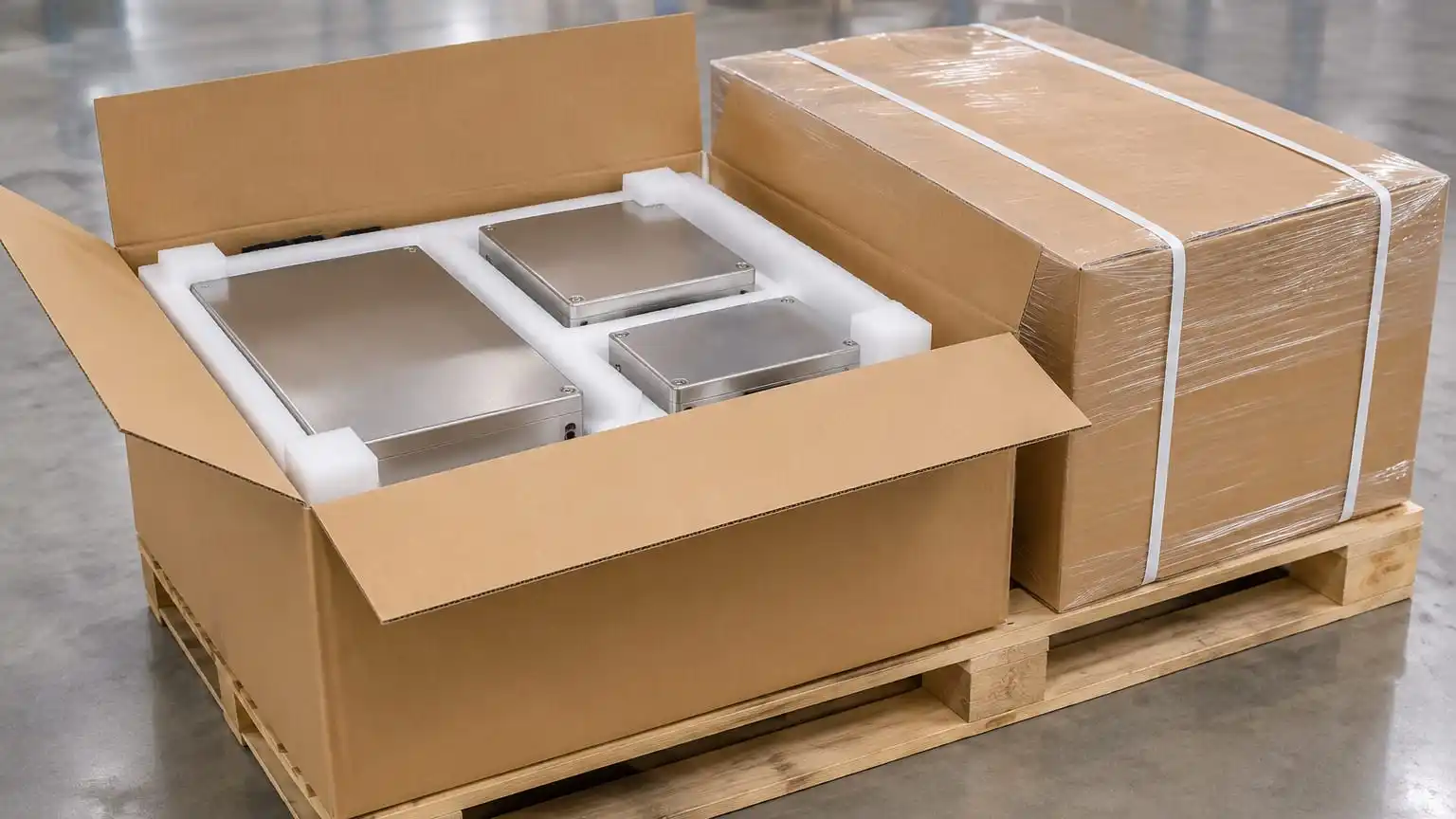
Custom-cut foam inserts, heavy-duty cartons and strapped palletizing protect finished metal enclosures during export transit.
A quoted lead time is only useful if it reflects the supplier's actual open capacity, not an optimistic estimate to win the order. Ask what happens if your order competes with another customer's larger order for the same equipment, and ask for packaging specifications for your destination: carton strength, corner protection, moisture barrier for ocean freight, and labeling that matches your import requirements. Underspecified packaging is a common cause of transit damage claims that have nothing to do with the part's manufacturing quality. For OEM and B2B buyers coordinating multiple SKUs, confirm whether CNC machining parts in the same order follow the same packaging and lead-time process as the stamped or formed sheet metal components.
Supplier vetting checklist: what to request before you commit
- Quality system evidence — ISO 9001 (or relevant) certificate, plus a description of how nonconformities and engineering changes are handled.
- Material traceability — mill test report or material certificate tied to a heat/batch number for the specific grade you ordered.
- First-article sample — a physical sample measured against your drawing's critical dimensions before mass production starts.
- Process capability for your part type — ask specifically about deep drawing, progressive stamping, laser cutting, press-braking or CNC machining experience relevant to your geometry; see our sheet metal fabrication and metal stamping parts capability pages for what a real capability statement should cover.
- Realistic lead time with capacity context — not just a date, but an explanation of current workload and how your order is scheduled.
- Export packaging specification — carton strength, cushioning, moisture protection and labeling matched to your shipping method and destination.
- Communication responsiveness during the quote stage — slow, vague answers to technical questions during sourcing often predict the same pattern during production issues.
Frequently asked questions
Is a direct factory always better than a trading company?
Not always. A direct factory gives you more control over engineering feedback, traceability and cost transparency, which matters most for custom or tolerance-sensitive parts. For a single simple, low-risk purchase, a trading company's convenience may outweigh the lost visibility.
What is the single most common mistake buyers make when vetting a new metal parts supplier?
Approving a production order based on photos or a verbal quality claim, without requesting a first-article sample measured against the drawing's critical dimensions.
How do I verify a material certificate is not generic or copied from another order?
Check that the mill test report's heat number or batch number is specific to your order and ask the supplier to show how that number is physically marked on the material or parts you receive.
Do online sourcing platforms provide the same traceability as a direct factory relationship?
Usually not for custom parts. Platforms are generally stronger for standardized, catalog-style components where specification risk is low, and weaker for traceability and engineering collaboration on custom tolerance-sensitive parts.
What should I ask about lead time besides the delivery date itself?
Ask what other orders are currently in the supplier's production queue and how your order is prioritized, so the quoted date reflects real capacity rather than an estimate.
Final recommendation
Treat supplier vetting as a documented process, not a one-time impression. Request the quality system evidence, the material certificate, and a first-article sample before any production commitment, and confirm lead time and packaging in writing. If your part also requires choosing between forming processes or refining the design for lower tooling cost, continue with our deep drawing vs progressive stamping vs sheet metal fabrication guide and our DFM and prototype-to-production guide. For a quote that already reflects these vetting standards, use our contact page to request a mill-test-report-backed quote with a first-article sample option.
Table of Contents
- Quick answer: how do you vet a custom metal parts supplier before placing an order?
-
Direct factory vs trading company vs online sourcing platform: who do you actually hold accountable?
- Quality management system: ask for the certificate, then ask how it is used
- Material certification and traceability: verify, don’t assume
- First-article sample review: the checkpoint that prevents a bad production run
- Lead time, production capacity and export packaging: the part buyers check last and regret most
- Supplier vetting checklist: what to request before you commit
-
Frequently asked questions
- Is a direct factory always better than a trading company?
- What is the single most common mistake buyers make when vetting a new metal parts supplier?
- How do I verify a material certificate is not generic or copied from another order?
- Do online sourcing platforms provide the same traceability as a direct factory relationship?
- What should I ask about lead time besides the delivery date itself?
- Final recommendation